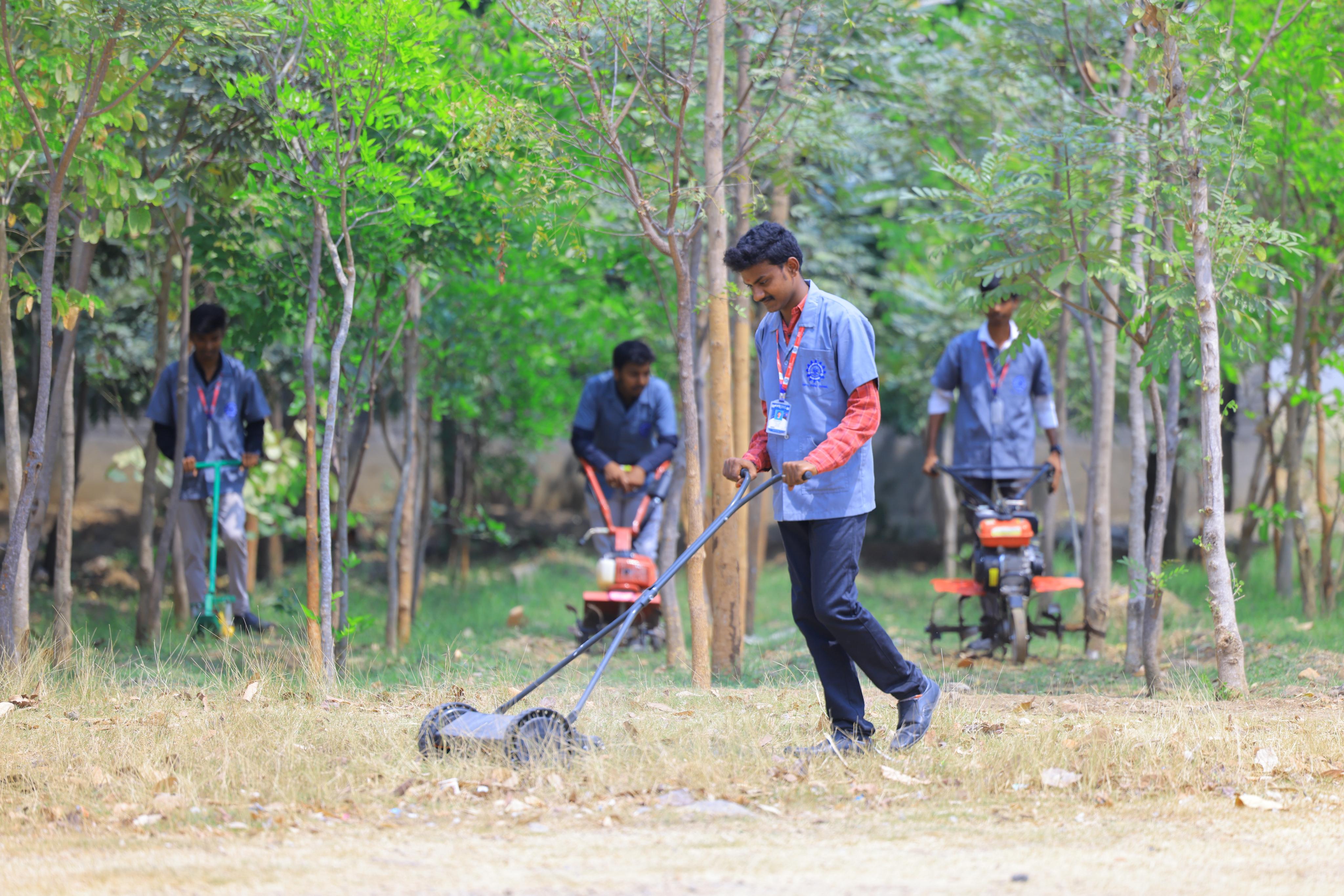
The Department of Agricultural Engineering was established in 2021 and offers a four-year B.Tech. programme, approved by AICTE and affiliated with Anna University, Chennai. The programme integrates engineering and agricultural sciences to enhance farm productivity, sustainability, and rural development.
The department provides quality education, practical training, and hands-on learning through qualified faculty, modern infrastructure, and well-equipped laboratories. Facilities include a Mechanized Farm with a four-wheel-drive tractor and farm machinery, CAD and GIS Laboratory, Farm Machinery Laboratory, Post-Harvest Technology Laboratory, Soil Science Laboratory, and Fluid Mechanics Laboratory.
Students gain practical exposure to crop husbandry, farm mechanization, post-harvest technology, soil and water conservation, CAD, GIS, and emerging agricultural technologies. Through skill development programmes, industry interaction, workshops, expert training, projects and research, the department prepares skilled and innovative professionals for modern and sustainable agriculture.
Agricultural Engineering graduates can build careers across agriculture, engineering, technology, industry, research and entrepreneurship. Key opportunities include:
To be a leading center of excellence in Agricultural Engineering, advancing sustainable agriculture through innovative education, cutting-edge research, and technology-driven solutions that enhance productivity, environmental stewardship, and rural development.
| S.No | AU-FIN | AICTE ID | Name of the Faculty | Designation | Photo |
|---|---|---|---|---|---|
| 1 | 2633991995 | 1-47920436090 | Dr SIVASAKTHI S | Associate Professor |

|
| 2 | 2678141994 | 1-11096586371 | Mr TAMILSELVAN K | Assistant Professor |

|
| 3 | 2661971998 | 1-44736743973 | Mrs SHARMILA B | Assistant Professor |

|
| 4 | 2780932003 | 1-47920436082 | Ms SOWMIYA N | Assistant Professor |

|
| 5 | 2798802001 | 1-47940812602 | Ms NIVETHA S | Assistant Professor |

|
| 6 | 2798382000 | 1-47940812610 | Ms THRIVENI K V | Assistant Professor |

|
| 7 | 2735781996 | 1-47940812618 | Mr VINODKUMAR S | Assistant Professor |

|
| 8 | 2663741993 | 1-9320992852 | Mr VIGNESWARAN M | Assistant Professor |

|
| 9 | 2634411989 | 1-2302896927 | Mr NANDHAKUMAR R | Assistant Professor |

|
| S.No | Date | Title of the Program | Chief Guest | Participants |
|---|---|---|---|---|
| 1 | 12.01.2026 | Pongal Celebration 2026 | — | 159 |
| 2 | 06.02.2026 | Seminar on enhancing students' industry exposure and professional knowledge | Mr. C. Mani Amudhan | 158 |
| 3 | 21.02.2026 | Alumni Meet 2026 | Dr. Srinivasan Appadurai | 155 |
| 4 | 27.02.2026 | Symposium – Uzhavu 2026 | Ms. Fizza Sallem | 158 |
| 5 | 11.03.2026 | Project Expo | Dr. Srinivasan Appadurai | 37 |
Students actively participate in project presentations, project expos, and final-year projects. Highlights from department records:
Detailed project titles and reports will be updated soon.
| Batch | Placement Percentage |
|---|---|
| 2021–2025 | 80% |
| 2022–2026 | 84% |
We are proud to celebrate the outstanding academic achievements of our students of the 2021–2025 batch who have secured prestigious ranks in Anna University examinations.

We are delighted to celebrate the remarkable achievement of Rahamathunnisha S. R., a 2023 Batch Final-Year Student, who secured First Prize and won the prestigious Gold Medal at the Interzonal Judo Competition held in Namakkal.

| S.No | Students Activities | No. of Students Participation / Recognitions |
|---|---|---|
| 1 | Symposium Paper Presentation / Seminar / Workshop / Conference / Webinar | 50 |
| 2 | Project Presentation | 108 |
| 3 | Implant Training / Internship / Extension Activities | 214 |
| 4 | Value Added Course | 267 |
| 5 | Technical Quiz | 67 |
| 6 | Non-technical Events | 78 |
| 7 | Sports | 10 |
| S.No | Particulars | Numbers |
|---|---|---|
| 1 | Publications – Articles / Books / Book Chapter / Conference Proceedings / Newsletters | 17 / 6 / 2 / 2 / 7 |
| 2 | Conference / Workshop / FDP / Seminar / Webinar / Symposium participated | 103 |
| 3 | Paper Presentation / Poster Presentation | 8 / 5 |
| 4 | Online Courses | 10 |
| 5 | Awards | 12 |
| 6 | Patent | 1 |

IEI offers Student Membership to students pursuing undergraduate engineering programmes such as B.E. and B.Tech. This membership provides students with opportunities to enhance their professional knowledge, engage in technical activities, and develop their skills and professional networks.
| Particulars | No. of Students | Membership Tenure |
|---|---|---|
| Student Member | 30 | Up to course completion |
| S.No | Name of the Institution / Industry | From | Duration |
|---|---|---|---|
| 1 | Thaiveedu Infra Builders, Madurai | 2026 | 5 Years |
| S.No | Category | Cumulative Acquisition as on Date |
|---|---|---|
| 1 | No. of Book Titles | 320 |
| 2 | No. of Book Volumes | 1750 |