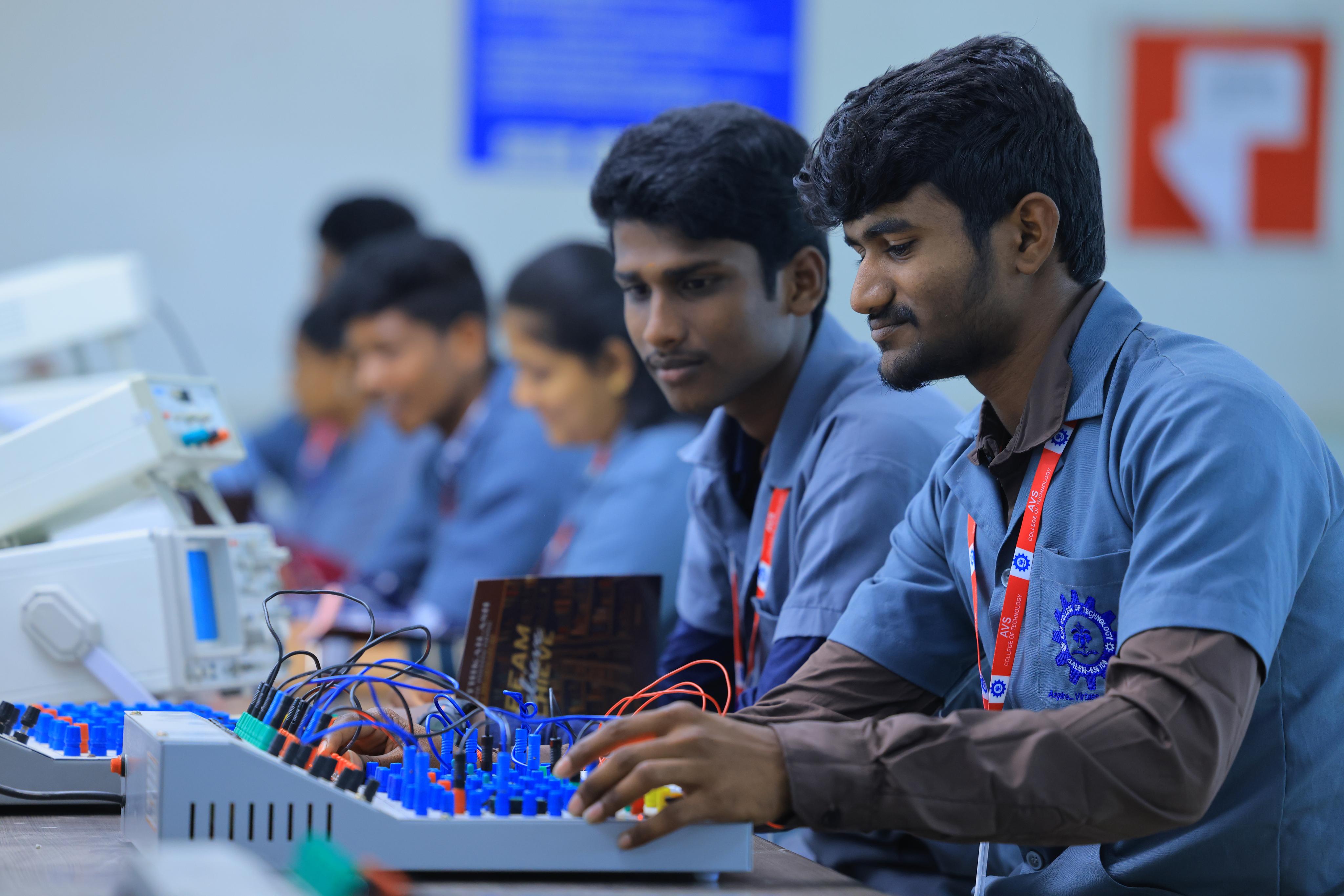
The Department of Electrical and Electronics Engineering was established in 2014 and offers a B.E. Degree Programme in Electrical and Electronics Engineering. The four-year undergraduate programme integrates engineering principles with powering the future through innovation, design, and smart technology. Our department bridges the gap between massive electrical power grids and micro scale electronic circuits. We prepare students and professionals to lead in fields like renewable energy, automation, and advanced computing. Explore our resources, projects, and research to see how we shape the modern world. The programme is approved by the All India Council for Technical Education (AICTE) and affiliated with Anna University, Chennai, and follows a curriculum designed to address the evolving technological needs of Modern Electrical Engineering.
The department is committed to providing students with theoretical knowledge, practical training, and hands-on experience in emerging and advanced technologies in electrical engineering. It is supported by highly qualified faculty members and technical staff, along with well-equipped laboratories and modern infrastructure that facilitate teaching, practical learning, innovation, and research.
The department provides hands-on experience in the design, testing, and operational analysis of alternating current (AC) and direct current (DC) machinery. It focuses on the application of solid-state electronics to the control and conversion of electrical power. The foundational workspace for analyzing components and configuring basic hardware systems. An air-conditioned computing facility powered by an enterprise server network and continuous UPS backups. The hub for programming embedded systems and deploying edge computing solutions.
The department provides academic and practical exposure of Electrical & Electronics Engineering and is dedicated to providing students with a comprehensive balance of academic knowledge and practical exposure. Our laboratory ecosystem serves as an experiential learning hub, transforming theoretical classroom concepts into tangible engineering solutions that match modern industry standards.
The department has well-equipped laboratories, including the Electrical Machinery Laboratory, Electronics Laboratory, Power System Laboratory, Power Electronics Laboratory, Control and Instrumentation Laboratory, and Microprocessor and Microcontroller Laboratory. These facilities provide opportunities for practical learning, project work, experimentation, and research.
To develop students' practical competencies and industry-oriented skills, the department regularly organizes skill development programmes, hands-on training, workshops, seminars, and expert interactions with support from industry professionals and subject experts. Students are also provided with opportunities to gain comprehensive knowledge. Graduates possess the foundational expertise required to design, analyze, and manage large-scale power infrastructures and sustainable energy systems.
Proficiency in load flow studies, short-circuit analysis, and transient stability modeling. Capability to design grid-connected solar PV networks, micro-wind turbine setups, and hybrid energy storage units. Expertise in testing, monitoring, and operating heavy alternating current (AC) and direct current (DC) motors, alternators, and multi-tap industrial transformers. Knowledge of implementing advanced metering infrastructure and automated distribution systems.
With its blend of electrical engineering technologies, practical training, industry interaction, and research-oriented learning, the Department of Electrical and Electronics Engineering strives to prepare competent professionals capable of addressing the technological challenges of modern and sustainable Electrical engineering.
Electrical and electronics graduates can build careers across electrical and electronics engineering, technology, industry, research and entrepreneurship. Key opportunities include:
| S.No | AU-FIN | AICTE ID | Name of the Faculty | Designation | Photo |
|---|---|---|---|---|---|
| 1 | 2675551976 | 1-11422579429 | Dr SELVARASU R | Professor |

|
| 2 | 2650791988 | 1-44725629544 | Dr BALAM SURESH KUMAR | Professor |

|
| 3 | 2691921987 | 1-3204956770 | Dr ALLAUDEEN A | Assistant Professor |

|
| 4 | 2669611993 | 1-3185031137 | Mrs THARANI S L | Assistant Professor |

|
| 5 | 2685261987 | 1-44724422798 | Mrs SANGEETHA S | Assistant Professor |

|
| 6 | 2654581992 | 1-7343286845 | Mrs VINCY JONES D | Assistant Professor |

|
| 7 | 2628601995 | 1-44724422522 | Mrs HEMALATHA S | Assistant Professor |

|
| 8 | 2613031983 | 1-26215994091 | Mr MANI M | Assistant Professor |

|
| 9 | 2793801976 | 1-433673873 | Mr SIVALINGAM R | Assistant Professor |

|
| 10 | 2771582002 | 1-47942040462 | Ms PRIYADHARSHINI V | Assistant Professor |

|
| S.No | Date of the Program | Title of the Program | Chief Guest Name | No. of Participants |
|---|---|---|---|---|
| 1 | 12.01.2026 | Pongal Celebration 2026 | — | 159 |
| 2 | 21.02.2026 | Alumni Meet 2026 | Dr. Srinivasan Appadurai | 155 |
| 3 | 27.02.2026 | Symposium – Uzhavu 2026 | Ms. Fizza Sallem | 158 |
| 4 | 11.03.2026 | Project Expo | Dr. Srinivasan Appadurai | 37 |
| 5 | 17.07.2026 | Integrated Sensing and Communication based Next Gen IoT | Dr. M. Muruganandham, Senior Lecturer, University of Technology & Applied Sciences, IBRI | 150 |
| 6 | 22.09.2026 | Alumni Interaction | Er. Surya V., Cyber Security Analyst, Airtel International, Chennai | 150 |
| 7 | 30.09.2026 | MoU Signing | Nithinson Jose G, Project Lead, GTT Foundation, Chennai | 150 |
| Batch | Percentage |
|---|---|
| 2022–2026 | 100% |
| 2021–2025 | 100% |
| 2020–2024 | 100% |
| 2019–2023 | 96% |
| 2018–2022 | 95% |
| 2017–2021 | 95% |
| # | Student(s) | Batch | Event | Award |
|---|---|---|---|---|
| 1 | V. Gowsik & Co. | IV Year | Non-Technical Event | Cash Award – ₹1000 |
| 2 | K. Mohamed Adhil & Co. | III Year | Project Expo | 2nd Prize – ₹1000 |
| 3 | C. Gurusamy | IV Year | Code Hacking | 2nd Prize – ₹1000 |
| 4 | C. Chandru | III Year | Short Film | 2nd Prize – ₹500 |
| 5 | D. Kaileshwaran | II Year | Judo – District Level | Gold Medal |
| 6 | D. Kaileshwaran | II Year | Judo – Anna University Sports Board | 2nd Place |


Certificates & awards received by students at district and university-level sporting events.
D. Kaileshwaran, II Year — Gold Medal at the Judo District-Level Championship, and 2nd Place at the Anna University Sports Board tournament.


| S.No | Particulars | Numbers |
|---|---|---|
| 1 | Publications – Articles / Books / Book Chapter / Conference Proceedings / Newsletters | 10 / 2 / 1 / 23 / 1 |
| 2 | Conference / Workshop / FDP / Seminar / Webinar / Symposium participated | 15 |
| 3 | Paper Presentation / Poster Presentation | 23 / 8 |
| 4 | Online Courses | 10 |
| 5 | Awards | 2 |
| 6 | Patent | 2 |
| 7 | Funded Project | 1 |

A small-scale horizontal-axis wind turbine with three orange-tipped blades, mounted on a metal tower and support frame — built entirely by EEE students.

A central vertical pole with branching arms holding small photovoltaic panels arranged to mimic a tree's canopy — developed by the Department of EEE at AVS College of Technology.

An automated mini-greenhouse prototype designed to optimise microclimate conditions — temperature, light and ventilation — for healthy plant growth.

A hybrid electric vehicle prototype developed by EEE students, integrating electric and conventional power sources for enhanced efficiency and performance.

ISTE offers Student Membership to students pursuing undergraduate engineering programmes such as B.E. and B.Tech. This membership provides students with opportunities to enhance their professional knowledge, engage in technical activities, and develop their skills and professional networks.
| Particulars | No. of Count | Membership Tenure |
|---|---|---|
| Student Member | 30 | Up to course completion |
| Faculty Member | 2 | Registered |
| S.No | Name of the Institution / Industry | From | Duration |
|---|---|---|---|
| 1 | GTT Foundation, Chennai | 2026 | 5 Years |
| 2 | Caliber Embedded Technology Pvt. Ltd., Salem | 2024 | 5 Years |
| 3 | Mikrosun Technology, Salem | 2023 | 5 Years |
| 4 | Mcoreta, Bangalore | 2022 | 5 Years |
| S.No | Category | Cumulative Acquisition as on Date |
|---|---|---|
| 1 | No. of Book Titles | 556 |
| 2 | No. of Book Volumes | 2250 |