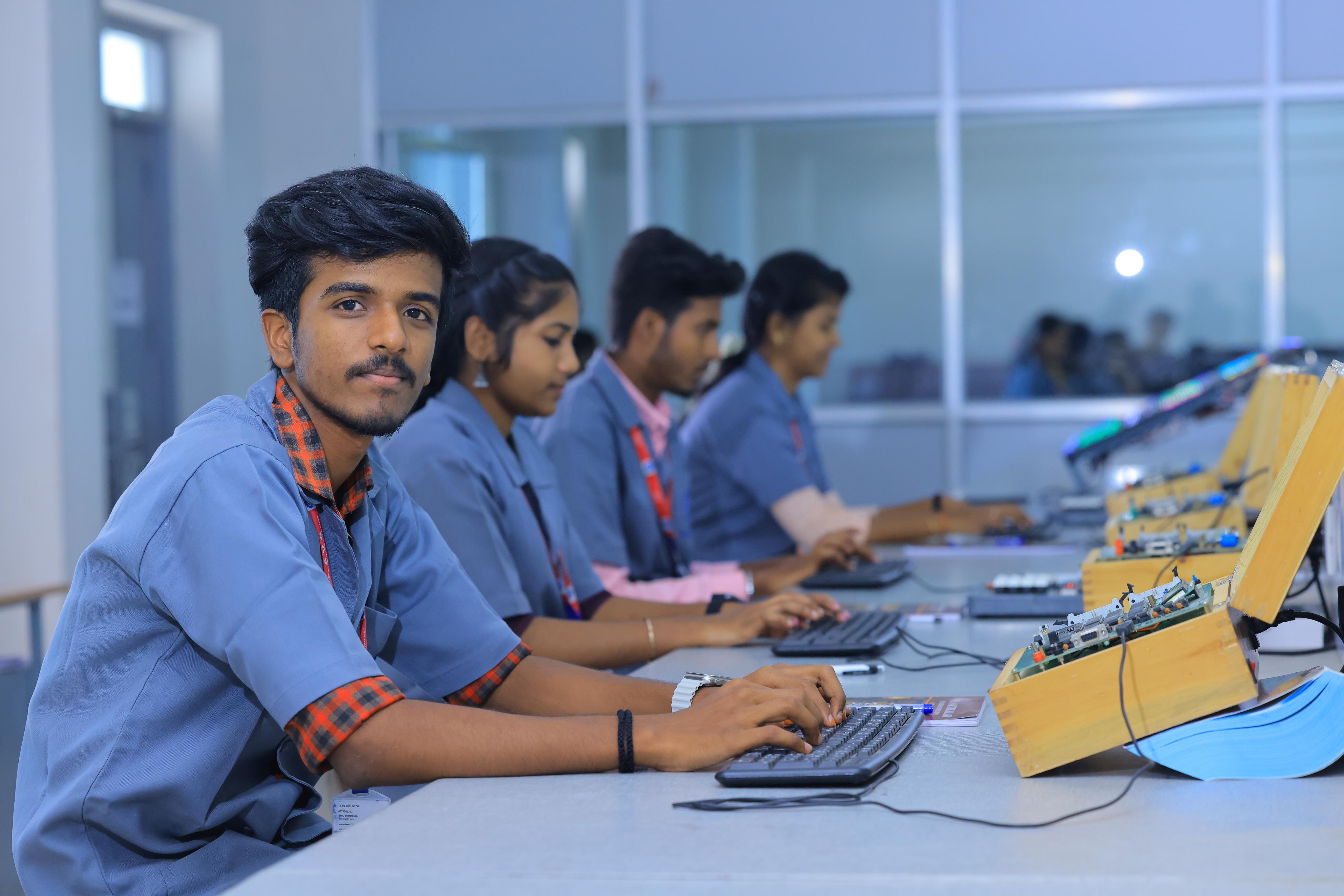
The Department of Electronics and Communication Engineering offers an undergraduate programme that builds strong foundations in electronic circuits, communication systems, signal processing, embedded systems and modern computing technologies. The programme is approved by AICTE and affiliated with Anna University, Chennai. The curriculum combines theoretical learning with practical training to prepare students for evolving technological fields.
The department is committed to providing students with theoretical knowledge, hands-on laboratory experience, project-based learning and exposure to emerging technologies. Qualified faculty members, technical staff and laboratory infrastructure support teaching, innovation and research.
The department provides practical learning through electronic circuits, communication, digital signal processing, microprocessors and microcontrollers, embedded systems, VLSI and related laboratory facilities. Students gain experience in circuit design, testing, simulation and prototype development.
The department provides academic and practical exposure in analog and digital electronics, communication engineering, signal processing, embedded systems, VLSI design, IoT and related areas. Laboratory facilities support practical learning, experimentation, project work and research.
To develop students' practical competencies and industry-oriented skills, the department organizes skill-development programs, hands-on training, workshops, seminars, industrial visits and expert interactions. Students are encouraged to undertake projects and participate in technical activities.
Through its blend of core engineering education, practical training, industry interaction and research-oriented learning, the department strives to prepare competent professionals for the electronics and communication technology sector.
The Department of Electronics and Communication Engineering was established in 2013 and offers a four-year B.E programme, approved by AICTE and affiliated with Anna University, Chennai.
The department provides quality education, practical training, and hands-on learning through qualified faculty, modern infrastructure, and well-equipped laboratories. The department is equipped with modern laboratories and facilities, including an Electronics and Communication Laboratory, Digital Signal Processing Laboratory, Microprocessor and Microcontroller Laboratory, Communication Systems Laboratory, Embedded Systems Laboratory, VLSI Laboratory, and Computer Networks Laboratory.
Students gain practical exposure to analog and digital electronics, communication systems, embedded systems, microcontrollers, signal processing, VLSI design, wireless communication, computer networks, IoT, and emerging electronic technologies. Through skill development programmes, industry interaction, workshops, expert training, projects, internships, and research activities, the department prepares skilled, innovative, and industry-ready professionals for the rapidly evolving fields of electronics and communication engineering.
Electronics and Communication Engineering (ECE) graduates have diverse career opportunities across core electronics, communication, software, embedded systems, automation, and emerging technologies.
| S.No | AU-FIN | AICTE ID | Name of the Faculty | Designation | Photo |
|---|---|---|---|---|---|
| 1 | 2616221979 | 1-7386099220 | Dr. SUTHANTHIRA VANITHA N | Principal / Professor |

|
| 2 | 2611851976 | 1-7528280845 | Dr SUJATHA C | Professor |

|
| 3 | 2622671971 | 1-421847242 | Dr N.R INDIRA | Professor |

|
| 4 | 2615971994 | 1-7365686235 | Mrs NIRMALA R | Assistant Professor |

|
| 5 | 2636691992 | 1-43875764601 | Mrs SUJITHRA M | Assistant Professor |

|
| 6 | 2637751986 | 1-3603590013 | Mrs VIJI S | Assistant Professor |

|
| 7 | 2788531996 | 1-47934734982 | Mrs VENKATESWARI A | Assistant Professor |

|
| 8 | 2635261994 | 1-10588699491 | Mrs SHANMUGAPRIYA M | Assistant Professor |

|
| 9 | 2651821987 | 1-10529854821 | Mr DINESH B | Assistant Professor |

|
| 10 | 2618231993 | 1-11096958091 | Mrs JAMUNA K | Assistant Professor |

|
| S.No | Date of the Program | Title of the Program | Chief Guest Name | No. of Participants |
|---|---|---|---|---|
| 1 | 12.01.2026 | Pongal Celebration 2026 | — | 120 |
| 2 | 21.02.2026 | Alumni Meet 2026 | Dr. Srinivasan Appadurai | 110 |
| 3 | 26.02.2026 | Symposium – EMPEZER'26 | Ms. Fizza Sallem | 145 |
| 4 | 07.04.2026 | Project Expo | Dr. Srinivasan Appadurai | 30 |
| 5 | 15.09.2026 | MoU Signing | Mr. M. Amarnath Karthik, EMBUZZ Technologies Pvt Ltd., CBE | 148 |
| Batch | Percentage |
|---|---|
| 2021–2025 | 100% |
| 2022–2026 | 100% |
| S.No | Students Activities | No. of Students Participation / Recognitions |
|---|---|---|
| 1 | Symposium Paper Presentation / Seminar / Workshop / Conference / Webinar | 35 |
| 2 | Project Presentation | 25 |
| 3 | Implant Training / Internship / Extension Activities | 42 |
| 4 | Value Added Course | 85 |
| 5 | Technical Quiz | 30 |
| 6 | Non-technical Events | 65 |
| 7 | Sports | 10 |
| S.No | Particulars | Numbers |
|---|---|---|
| 1 | Publications – Conference Proceedings | 2 |
| 2 | Conference / Workshop / FDP / Seminar / Webinar / Symposium participated | 20 |
| 3 | Paper Presentation | 8 |
| 4 | Online Courses | 10 |

ISTE offers Student Membership to students pursuing undergraduate engineering programmes such as B.E. and B.Tech. This membership provides students with opportunities to enhance their professional knowledge, engage in technical activities, and develop their skills and professional networks.
| Particulars | No. of Count | Membership Tenure |
|---|---|---|
| Student Member | 20 | Up to course completion |
| S.No | Name of the Institution / Industry | From | Duration |
|---|---|---|---|
| 1 | EMBUZZ TECHNOLOGIES PVT Ltd., CBE | 2026 | 5 Years |
| S.No | Category | Cumulative Acquisition as on Date |
|---|---|---|
| 1 | No. of Book Titles | 120 |
| 2 | No. of Book Volumes | 600 |